SUNLU
S4 Filament Dryer
The SUNLU S4 is the best launch pick for a printer owner who has moved past one open PLA roll and now needs an actual humidity-control station. It is not the cheapest way to dry a spool, but it is the most coherent way to keep several filaments usable, print from the box, and stop treating wet PETG or nylon as a printer-tuning mystery.
Street check
$169
Decision snapshot
What this product actually solves
Print Climate reviews gear by the missing condition: drying, storage, enclosure control, resin boundaries, or abrasive hardware readiness.
9.1
fit score
Buy it for
- Four-spool capacity makes it the cleanest single purchase for AMS-style benches, color swaps, and households with several open rolls.
- Active heat plus circulation solves the two-part drying problem: warming the spool and moving humid air away from the filament surface.
- Print-through workflow reduces the chance that a dried nylon, TPU, or PETG spool immediately reabsorbs moisture while a long job runs.
Check first
- Overkill for a one-printer PLA bench where a sealed storage box and occasional single-spool dryer would do the job.
- Large footprint demands a real bench position, not a corner shelf.
- Multi-spool dryers do not replace labeled dry storage; partial rolls still need sealed long-term storage after the print.
At a Glance
Best For
Fit check
Before this belongs in the cart
The right purchase should remove one specific workshop constraint. Use these checks before clicking through to Amazon.
Confirm
- You have bench space for a four-spool appliance and lid clearance.
- Several rolls are active at once, not just one damp PETG spool.
- Your priority materials share compatible drying cycles.
- You still have sealed storage for rolls after the dry cycle.
Pair with
- Dedicated dry boxes for nylon, TPU, PETG-CF, and opened specialty rolls.
- Spool labels showing material, dry date, desiccant status, and print-through readiness.
- A room hygrometer near the printer if the bench lives in a garage or basement.
Skip if
- The printer mostly runs fresh PLA in a conditioned room.
- One compact dryer plus storage would solve the actual failure.
- The station would sit far enough away that print-through routing becomes awkward.
Bench note
Overview
The SUNLU S4 is the dryer to consider when the bench has stopped being a one-spool hobby. Four open rolls, PETG that strings after a weekend, TPU that behaves differently every job, and AMS-style color changes all point to the same problem: you do not need one emergency dryer, you need a small drying station.
Print Climate treats the S4 as a workflow product, not just a heated box. Its value is the combination of four-spool capacity, active heat, circulation, humidity visibility, and print-through routing. That combination can turn drying from a rescue chore into the default place priority filament lives while a long print runs.
The tradeoff is size and specificity. The S4 makes sense when several rolls are active at once. It is harder to justify for a single PLA printer, and it does not remove the need for labeled sealed storage after the dry cycle. Buy it when the bench needs a repeatable humidity-control station, not when one damp spool needs a one-time rescue.
The buyer should think of the S4 as the center of a small bench protocol: dry compatible materials together, print from the station when the material is sensitive, move finished spools to sealed boxes, and label the state of each roll. That is what makes the S4 convert better than another small accessory. It changes where filament lives while the printer is working.
Pros & Cons
Pros
- Four-spool capacity makes it the cleanest single purchase for AMS-style benches, color swaps, and households with several open rolls.
- Active heat plus circulation solves the two-part drying problem: warming the spool and moving humid air away from the filament surface.
- Print-through workflow reduces the chance that a dried nylon, TPU, or PETG spool immediately reabsorbs moisture while a long job runs.
- The higher price is easier to justify when you would otherwise buy two single-spool dryers plus separate dry boxes.
Cons
- Overkill for a one-printer PLA bench where a sealed storage box and occasional single-spool dryer would do the job.
- Large footprint demands a real bench position, not a corner shelf.
- Multi-spool dryers do not replace labeled dry storage; partial rolls still need sealed long-term storage after the print.
Design & Build Quality
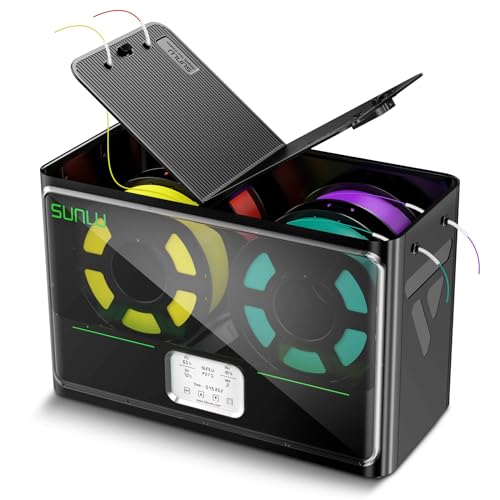
The S4 is physically closer to a bench appliance than a small accessory. The four-spool chamber gives it a broad footprint, but that size is the point: it keeps several active materials in one controlled station instead of scattering single dryers and storage boxes across the room. The hinged lid, spool rollers, filament exits, and front controls are all built around print-through use rather than storage-only use.
The casing is consumer appliance quality, not lab equipment. It belongs on a stable shelf or side bench where the lid can open fully and filament paths can run without sharp bends. The important build detail is not luxury finish, it is whether the station stays convenient enough that users actually return PETG, TPU, and nylon to it after prints.
Before buying, measure more than the footprint. Measure the path from dryer to printer, the lid swing, the height under shelves, and where tubes will route if the printer moves during a job. A four-spool dryer that sits in the wrong corner becomes a storage bin. A four-spool dryer beside the machine becomes the default material station.
Performance & Specifications Deep Dive
The S4's best spec is capacity. Four 1 kg spools in one heated, circulated chamber changes the math for users who rotate colors or materials. A single-spool dryer can prove that moisture was the problem; a four-spool dryer can keep the workflow from collapsing again next week.
The listed 70 C class temperature range fits PLA, PETG, TPU, and many nylon drying routines. For high-performance engineering materials, buyers should still check the filament manufacturer's drying guidance, because temperature, duration, and ventilation needs vary by blend. The S4 should be seen as a strong hobbyist drying station, not as an industrial oven.
The humidity display is useful because it makes the room visible. If humidity drops during a cycle and then climbs as soon as the lid opens or the room changes, the user learns that storage discipline is part of the solution. That visibility is one reason this station can convert a frustrated buyer: it explains the failure rather than only heating the spool.
The S4 also helps separate two questions that hobbyists often mix together. Did the filament improve after heat and airflow? Did the improvement survive storage and printing? A single-spool dryer can answer the first question. A multi-spool station with print-through routing gets closer to the second, especially when the user is printing PETG, TPU, nylon, or long color-swap jobs in humid weather.
Software & User Experience
The S4's interface is simple enough for a workshop rhythm: set material, set temperature and time, watch humidity, then print from the station when the material deserves it. That matters because drying fails when the procedure is annoying. A dryer hidden under a desk will not save a nylon roll that gets left open overnight.
The main user-experience constraint is mixed-material scheduling. Four spools in one station are convenient, but they may not all want the same drying cycle. A bench printing PLA, PETG, TPU, and nylon at the same time still needs labels and judgment. The S4 is strongest when the active spools have compatible drying needs or when the user runs separate cycles intentionally.
The workflow should be boring. Put like materials together, run the cycle, note the date, and return each spool to a labeled dry box if it is not actively feeding the printer. If a buyer expects the S4 to remember every material state for them, they will still end up with mystery rolls. The dryer supplies heat and visibility; the labels supply memory.
Real-World Use Cases
The best use case is a multi-spool FDM bench where PETG or TPU failures keep returning. Instead of drying one roll, printing once, and leaving the next roll exposed, the S4 gives the user a controlled place for the active materials. That makes it a natural fit for AMS-style workflows, color swaps, and households where several partial spools are always open.
It also works as the premium move for nylon and flexible-filament users who print long jobs. Print-through routing reduces the chance that a carefully dried spool absorbs room humidity during a twelve-hour print. The limitation is that a dryer is not a slicer fix. If popping disappears but blobs, under-extrusion, or poor bridging remain, the next step is temperature, speed, and retraction tuning.
For basic PLA benches, the S4 is usually too much. A small dryer plus a few dry boxes will solve more cheaply. Print Climate would push a buyer toward the S4 only when the problem is repeated across several rolls or when the bench is clearly moving into multi-material planning.
The S4 is also useful in shared maker spaces and family benches where nobody remembers who opened which roll. A visible station creates a default answer: active materials go here, backup materials go in labeled storage, and anything wet gets flagged before the next print. That social workflow is a real advantage over a single hidden dryer.
Who Should Buy (And Who Shouldn't)
Buy the S4 if the bench has three or four active rolls, if PETG or TPU sits open between jobs, or if the user wants one visible station for drying and print-through control. It is also the easiest recommendation for someone who already knows wet filament is a recurring problem and wants fewer small boxes on the bench.
Skip it if the printer mostly runs PLA, if space is tight, or if the budget would leave no room for dry storage boxes and desiccant. A four-spool dryer without a storage habit is still only half of the system. Users who print one roll at a time should start with a compact dryer and upgrade only when the workflow demands it.
The buyer who should act fastest is the one who keeps blaming slicer profiles after multiple materials degrade in the same room. One wet roll can be a bad storage incident. Three wet rolls usually means the bench process is broken. The S4 is for that second situation.
Alternatives Worth Considering
The SUNLU S2 is the better first dryer for a one-printer desk. It gives the same diagnostic habit in a smaller body and leaves money for dry boxes. The Creality Filament Dryer Box 2.0 is the value alternative when price matters more than station capacity.
The Polymaker PolyDryer system is the more modular approach. It separates active drying from sealed storage and is better for users who want one box per priority material. Generic hygrometer dry boxes are cheaper for bulk storage, but they do not actively dry a wet spool.
Creality's newer Space Pi Plus and SpacePi X4 are worth watching for buyers who want dual-spool or higher-temperature Creality hardware, but Print Climate should not push them ahead of the S4 without a stable Amazon listing, a reliable image path, and clear availability. For this page, the safer recommendation is the proven live-linked S4 for multi-spool 70 C drying, then storage products around it.
Our Verdict
The SUNLU S4 is the best launch pick for a printer owner who has moved past one open PLA roll and now needs an actual humidity-control station. It is not the cheapest way to dry a spool, but it is the most coherent way to keep several filaments usable, print from the box, and stop treating wet PETG or nylon as a printer-tuning mystery.
| Full Specifications | |
|---|---|
| Category | Filament dryer |
| Role | Multi-spool drying station |
| Max Temp | 70C |
| Capacity | 4 spools |
| Active Heat | Yes |
| Active Airflow | Yes |
| Humidity Readout | Yes |
| Print Through | Yes |
| Ventilation | No |
| Resin Workflow | No |
| Abrasive Ready | No |
| Best Materials | PETG, TPU, nylon, PLA+ |
| Footprint | Large bench station |
Frequently Asked Questions
Is the SUNLU S4 better than buying two single-spool dryers?
Can the SUNLU S4 replace dry boxes?
Is 70 C enough for nylon?
Does the S4 fix stringing automatically?
Who should not buy the S4?
Can I dry different materials together in the S4?
Is the S4 airtight enough for long-term storage?
What should I buy with the S4 on day one?
Related Buying Guides
Compare With Similar 3D Printer Environment Upgrades
Head-to-Head Comparisons
SUNLU S4 Four-Spool Filament Dryer
$169
Prices may change - check current Amazon listing.