Polymaker
PolyDryer Box
The Polymaker PolyDryer Box is the cleanest answer for users who already understand that drying and storage are different jobs. It is less exciting than a heated dryer, but it is often the missing step that keeps a fixed PETG or nylon problem from coming back two days later.
Street check
$55
Decision snapshot
What this product actually solves
Print Climate reviews gear by the missing condition: drying, storage, enclosure control, resin boundaries, or abrasive hardware readiness.
8.7
fit score
Buy it for
- Better as a system component than a one-off box: dry a spool, seal it, label it, and keep it ready.
- Humidity visibility makes it easier to catch when desiccant or sealing habits have stopped working.
- Modular dry-box workflow is ideal for users who rotate specialty materials but do not print each one daily.
Check first
- Dry storage is not active drying; a wet spool still needs a drying cycle before storage helps.
- Costs more than generic gasket boxes when you need to store many rolls.
- Capacity planning matters: one box per priority material adds up quickly.
At a Glance
Best For
Fit check
Before this belongs in the cart
The right purchase should remove one specific workshop constraint. Use these checks before clicking through to Amazon.
Confirm
- The spool is already dry, or you also own an active dryer.
- This box is for priority filament, not every cheap PLA backup roll.
- You value a cleaner print-through path more than lowest cost per stored spool.
- You can maintain desiccant and pay attention to the humidity reading.
Pair with
- A single-spool dryer for rescue cycles before storage.
- One box per expensive or moisture-sensitive material.
- A dry-date label so the box records state, not just brand and color.
Skip if
- You need active drying and do not own the dock or another dryer.
- The goal is cheapest bulk shelf storage.
- The spool is low-value PLA that rarely fails from moisture in your room.
Bench note
Overview
The Polymaker PolyDryer Box is the product that makes the most sense after a buyer learns the difference between drying and storage. A dryer rescues a spool. A sealed box protects the rescue. The PolyDryer system is built around that second habit, with enough structure to feel more reliable than a random tote and a loose packet of desiccant.
Print Climate should position this as a workflow component, not a miracle box. Its value is visible storage discipline: a dedicated spool box, humidity feedback, desiccant management, and print-through capability. That is exactly what keeps PETG, TPU, nylon, and specialty filaments from sliding back into the same failure cycle.
It costs more than generic storage, so the buying case must be clear. Put the PolyDryer Box on priority materials first: nylon, TPU, PETG-CF, expensive colors, and anything that already proved moisture-sensitive on the user's bench.
The key wording is `box`, not `dryer`, unless the buyer is also purchasing the PolyDryer dock. This review treats the standalone box as premium sealed storage. That makes the recommendation more honest and more useful, because disappointed buyers usually expected passive storage to do active drying work.
Pros & Cons
Pros
- Better as a system component than a one-off box: dry a spool, seal it, label it, and keep it ready.
- Humidity visibility makes it easier to catch when desiccant or sealing habits have stopped working.
- Modular dry-box workflow is ideal for users who rotate specialty materials but do not print each one daily.
- Pairs naturally with active dryers instead of trying to replace them.
Cons
- Dry storage is not active drying; a wet spool still needs a drying cycle before storage helps.
- Costs more than generic gasket boxes when you need to store many rolls.
- Capacity planning matters: one box per priority material adds up quickly.
Design & Build Quality
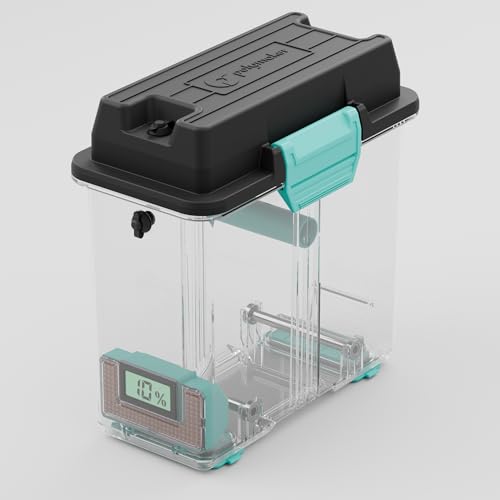
The PolyDryer Box is a purpose-built spool container with a sealed format, desiccant path, humidity visibility, and a feed route for print-through use. Compared with generic food-storage boxes, the value is integration. The buyer does not have to improvise spool bearings, tube exits, or hygrometer placement.
Build quality is best judged by repeat use. The lid, seal, spool path, and desiccant access all need to stay convenient. If opening and relabeling the box is annoying, the storage habit fails. This is why the PolyDryer is strongest for priority rolls rather than every cheap PLA color.
The physical advantage is not that the box looks nicer on a shelf. It is that a sensitive spool can stay in a known container while feeding the printer. A clean feed path reduces the temptation to open the lid for every job, which is exactly how a freshly dried TPU or nylon roll starts drifting back toward room humidity.
Performance & Specifications Deep Dive
The most important performance spec is not temperature, because the box is primarily storage. The important specs are sealing, humidity feedback, spool capacity, print-through path, and compatibility with Polymaker's drying ecosystem. That makes it a different buying decision than a SUNLU S2 or S4.
The PolyDryer Box protects a dry spool by slowing moisture uptake. It does not magically reset a wet spool by sitting on the shelf. If a roll is already popping and stringing, dry it first, then move it into the box. This distinction should be repeated on the page because it prevents disappointed buyers.
For nylon and TPU users, the visible humidity readout is valuable. It turns desiccant from a forgotten consumable into a maintenance loop. When the reading rises, the user knows the box, seal, or desiccant needs attention before the next job.
The performance metric that matters is how long a dried spool stays predictable. A generic box can work if it seals well, but the PolyDryer Box gives the buyer a more purpose-built path for keeping that state visible while printing. That is why it can justify a higher price for one or two critical materials even when it would be too expensive for an entire PLA shelf.
The maintenance rhythm should be part of the purchase decision. If the user will not recharge desiccant, check the reading, or close the feed path correctly, a premium box will slowly become a premium-looking failure. If the user does maintain it, the box becomes an early-warning system: humidity rises before the print fails.
Software & User Experience
There is no software layer, which is a good thing for this category. The user experience is the storage ritual: dry the spool, label it, put it in the box, check humidity, print through when needed, and return the spool immediately after the job.
Print Climate should make that ritual explicit. A premium dry box converts best when the buyer understands that the product saves future tuning time. It is not only a container; it is a reminder that the filament has a state.
The box should get a short label even though it has a humidity display. The display answers `what is happening now`. The label answers `when was this spool dried, what material is inside, and should I trust it for a long print`. Together, those two signals prevent the common failure where every dry box slowly becomes a mystery box.
Real-World Use Cases
The strongest use case is specialty material rotation. If a user owns nylon, TPU, PETG-CF, or glow filament but does not print those rolls every day, the PolyDryer Box gives each priority material a controlled home.
It also works well as the second purchase after a single-spool dryer. A buyer dries the PETG in a SUNLU S2 or Creality Filament Dryer Box 2.0, then stores it in the PolyDryer Box so the problem does not return. That pairing is more convincing than pretending one product handles the whole lifecycle.
The weak use case is bulk cheap storage. If someone has ten partial PLA rolls, a generic four-pack of hygrometer boxes may be more economical. The PolyDryer Box should be reserved for materials where failure costs more than the box.
A practical setup might use two PolyDryer Boxes for nylon and TPU, then cheaper boxes for ordinary PETG and PLA+. That hybrid stack is easier to justify than buying premium boxes for everything. It also teaches the buyer to rank filament by moisture sensitivity and replacement cost, not by brand loyalty.
This is the product for users who have already learned from a failure. They dried a roll, got a clean print, stored it casually, and watched the same symptoms return. The PolyDryer Box is not a first lesson. It is the follow-through purchase after the lesson becomes obvious.
Who Should Buy (And Who Shouldn't)
Buy it if the user has a few expensive or moisture-sensitive rolls that need their own protected lane. It is also a good fit for buyers who value a clean print-through path and do not want to build a DIY dry box.
Skip it if the spool is already wet and there is no dryer in the plan, or if the goal is simply cheapest cost per stored roll. In those cases the better recommendation is active drying first, then cheaper sealed storage.
This is also a good buy for the user who already owns a dryer but still sees failures return. That pattern usually means the dry cycle worked and the post-cycle storage did not. The PolyDryer Box turns the period after drying into part of the workflow instead of a shrug. It is a habit product, not a decoration for a filament shelf.
Alternatives Worth Considering
The SUNLU S2 and Creality Filament Dryer Box 2.0 are better first products when the spool needs active drying. The SUNLU S4 is better when several spools need heat and print-through access at once.
Generic hygrometer dry boxes are the budget alternative for bulk storage. They cost less per spool, but the buyer must inspect seals, manage desiccant, and accept a less integrated feed path.
The full PolyDryer dock-and-box ecosystem is the natural step up if the buyer wants Polymaker's active drying path too. That should be considered a different purchase than the standalone box. The standalone box protects a state; the dock helps create that state.
Our Verdict
The Polymaker PolyDryer Box is the cleanest answer for users who already understand that drying and storage are different jobs. It is less exciting than a heated dryer, but it is often the missing step that keeps a fixed PETG or nylon problem from coming back two days later.
| Full Specifications | |
|---|---|
| Category | Dry storage |
| Role | Sealed spool storage |
| Max Temp | 0C |
| Capacity | 1 spool |
| Active Heat | No |
| Active Airflow | No |
| Humidity Readout | Yes |
| Print Through | Yes |
| Ventilation | No |
| Resin Workflow | No |
| Abrasive Ready | No |
| Best Materials | Stored PETG, nylon, TPU |
| Footprint | Stackable dry box |
Frequently Asked Questions
Can the Polymaker PolyDryer Box dry wet filament by itself?
Is this worth it over generic dry boxes?
Should every spool get its own PolyDryer Box?
Can I print from the box?
What should I check after buying it?
Do I need the PolyDryer dock too?
Which filament gets the PolyDryer Box first?
How often should I recharge desiccant?
Related Buying Guides
Compare With Similar 3D Printer Environment Upgrades
Head-to-Head Comparisons
Polymaker PolyDryer Box
$55
Prices may change - check current Amazon listing.